How to Detect Fake Mortgage Leads Before They Cost You

Last Updated: November 3, 2026
Quick Summary
To detect fake mortgage leads, validate contact data at intake, cross-check identity against public records, reconcile application details for contradictions, and make live contact before anyone works the record. Assign every lead a disposition code so confirmed fakes are logged against their source and campaign.
- Disposable email domains, failed phone lookups, and mismatched area codes and addresses are early red flags.
- Capture a campaign ID and timestamp at intake so you can trace fake-rate spikes back to a source.
- Ask open qualifying questions on first contact; a genuine borrower knows their own property and loan numbers.
- Track contact rate, qualification rate, fake rate, conversion rate, and cost per close for every campaign.
- The most common false positive is a real borrower who only responds by text, so use more than one channel.
Table of Contents
- Why Fake Mortgage Leads Slip Through Standard Intake
- Fake Mortgage Lead Red Flags to Screen For First
- How to Verify Mortgage Leads Step by Step
- Mortgage Lead Qualification Questions That Expose Gaps
- Mortgage Lead Validation Tools and What Each One Checks
- Fake Lead or Real Borrower Who Went Quiet
- Measuring Lead Source Quality Over Time
- Registering as a Buyer With Verified Transfer Standards
- Frequently Asked Questions
Why Fake Mortgage Leads Slip Through Standard Intake
Fake mortgage leads survive because most intake forms ask for just enough to look complete. A name, an email, a phone number, a loan amount.
Loan officers can pay for records that were never a real borrower, then blame their sales team when nothing closes. The problem is upstream.
Here is the core issue. A form fill proves someone typed. It does not prove someone intends to borrow. Our Frequently Asked Questions explain how our intake and lead quality process works.
Below, we break down the red flags, a five-step verification workflow, and how to tell a fake lead from a real borrower who simply went quiet. The distinction matters more than most brokers realize.
Fake Mortgage Lead Red Flags to Screen For First
The fastest way to catch a fake mortgage lead is to look at what does not fit. Fraud rarely hides in one field. It shows up in the mismatch between fields.
Contact Data That Does Not Hold Up
Start with the contact details. They are the cheapest thing to fake and the easiest thing to test.
- Disposable email addresses. Domains tied to throwaway inbox services are a strong signal.
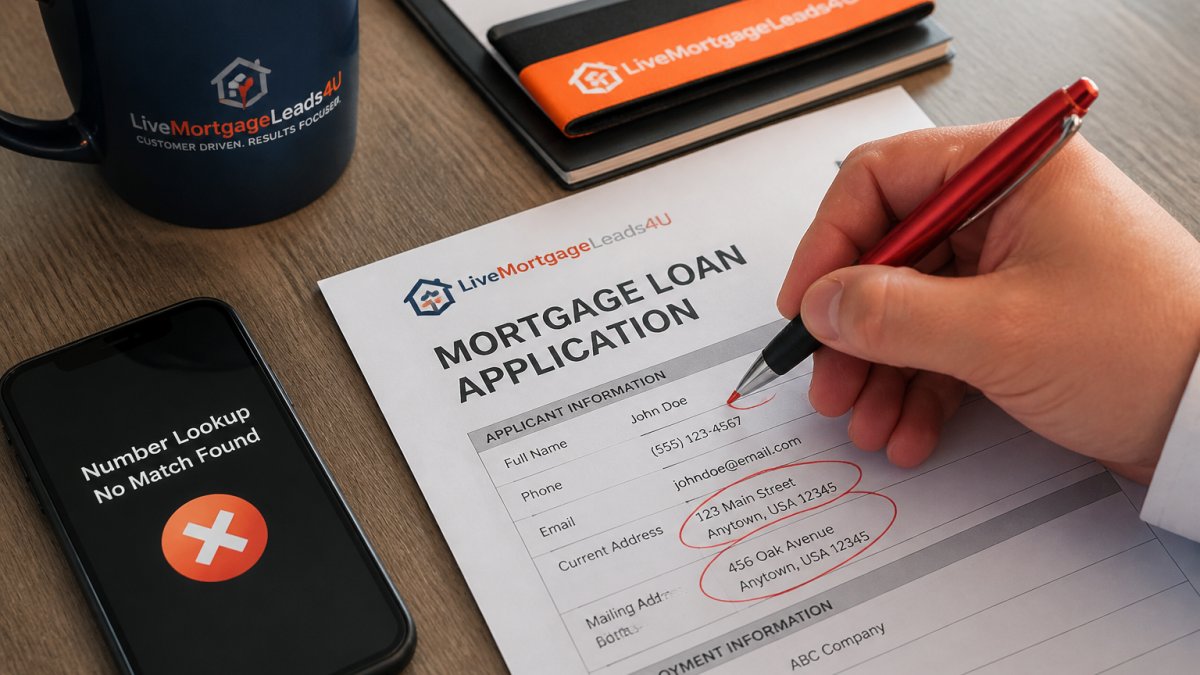
- Phone numbers that fail a basic lookup. No carrier match, no line type, or a number that routes to a virtual service.
- Area code and address that disagree. A borrower listing a home address in one region with a phone tied to another deserves a second look.
- Duplicate records across sources. The same name and number appearing under multiple submissions suggests a recycled or farmed record.
None of these proves fraud alone. Two or three together usually does.
Application Details That Contradict Themselves
Now read the application like an underwriter would. Inconsistencies are where fake mortgage leads fall apart.
- Stated income that does not match the stated employer or job title
- A loan amount that does not fit the property value or the borrower’s stated goals
- Employment dates that overlap or leave unexplained gaps
- A co-borrower listed with no contact information
- An address history that jumps between states in impossible timeframes
A common mistake is treating one odd field as a dealbreaker. Real borrowers mistype. Fake records contradict themselves across multiple fields at once.
How to Verify Mortgage Leads Step by Step
Verification is a process, not a gut check. Run the same steps on every lead, in the same order, and document the result so a second reviewer can reach the same conclusion. The workflow below is built for lead-level screening, not for underwriting a loan.
A Five-Step Verification Workflow
Step 1: Validate contact data at intake. Run the phone number, email, and address through validation before the record reaches a queue.
Step 2: Confirm identity basics. Cross-check the name, address, and phone against public records and against each other.
Step 3: Reconcile the application. Compare stated income, employment, loan purpose, property address, and loan amount for internal contradictions.
Step 4: Make live contact. A short call can confirm a real person with a real intent. Ask one open qualifying question and listen for a coherent answer that matches the application.
Step 5: Score and route. Assign a disposition code to every lead: clean, review, or reject. Send clean leads to loan officers. Send flagged leads to a review queue before anyone spends time on them.
Intake Fields That Make the Workflow Work
The workflow only works if intake captures the fields the steps need. At minimum, capture: full name, phone, email, property address, stated loan amount, stated loan purpose, stated income, employer, co-borrower names, lead source, campaign ID, and timestamp. Without a campaign ID, you cannot measure source quality later. Without a timestamp, you cannot tell a fresh record from a recycled one.
Watch out: teams often skip the campaign ID because it slows the form down, then discover months later that they cannot trace a fake-rate spike back to a source.
Disposition Codes and Timing
Set a service-level target for each step. Contact validation should run promptly after intake, and identity and application reconciliation should run before the first outbound call. Review-queue leads should be resolved on a defined schedule so the queue does not become a graveyard.
A common pattern is to let flagged leads sit in review until they age out, which defeats the purpose. The review queue is for decisions, not storage.
Check Exclusive Lead Availability in Your Target States
Connect with pre-screened borrowers actively seeking mortgage solutions in your licensed territory. High-intent, exclusive transfers delivered straight to your loan officers.
The goal is not to reject everyone. It is to catch the obvious fakes before your team invests hours, and to keep a record of what was caught so the source conversation is grounded in data.
Mortgage Lead Qualification Questions That Expose Gaps
A real borrower can answer basic questions about their own situation. A fake record usually cannot.
Ask these on the first live contact:
Register to Buy Mortgage Leads →
- What is the property address, and do you own it?
- What is your current loan balance and rate?
- What is driving the timing right now?
- Who else is on the loan or the title?
- What is the best number and time to reach you?
Watch for vague answers, scripted responses, or a caller who cannot name the property. A genuine borrower knows their own numbers.
One insider tip: ask an open question, not a yes-or-no one. “Tell me about the property” exposes a fake faster than any checklist.
Mortgage Lead Validation Tools and What Each One Checks
Tools speed up verification, but each one checks a different thing. Knowing what each covers prevents false confidence.
- Phone validation tools check line type, carrier status, and whether a number is active.
- Email validation tools flag disposable domains, syntax errors, and known spam traps.
- Identity and address tools cross-check names and addresses against public records.
- Duplicate detection catches the same record submitted across multiple campaigns.
No single tool proves a lead is real. Stack them and read the results together. For a deeper look at quality filters and consent checks, see our guide on how to buy live mortgage leads that actually convert.
Fake Lead or Real Borrower Who Went Quiet
Not every silent lead is fake. This is where brokers waste the most money, and where the wrong conclusion costs the most. Discard a real but quiet borrower and you lose a loan; keep working a confirmed fake and you burn hours that should have gone to a live prospect.
A real borrower goes quiet for ordinary reasons. They got busy. They are comparing lenders. They are not ready yet. A fake lead goes quiet because there was never a borrower. The difference shows up in the data, and it also shows up in how the lead responds to different kinds of outreach.
| Signal | Fake Lead | Real but Quiet Borrower |
|---|---|---|
| Contact data | Fails validation | Valid, reachable |
| Application | Contradicts itself | Consistent |
| Response to outreach | Never responds | Responds eventually |
| Property details | Cannot confirm | Confirms accurately |
| Response channel | Ignores every channel | Responds to one channel (often text or email) |
| Timing | No change over weeks | Re-engages when timing shifts |
Handling Rules for Each Outcome
Treat a real but quiet borrower with a structured follow-up sequence: a first call, a text or email touch, a second call at a different time of day, and a final written check-in before the lead is moved to a long-term nurture list. The sequence should run for a defined window, not indefinitely.
Treat a confirmed fake as a data problem, not a sales problem. Log the disposition, tag the source and campaign, and route the record to the review queue rather than back to a loan officer.
Watch out: the most common false positive is a real borrower who only responds by text. Teams that call only, and never text, misclassify reachable borrowers as fakes and discard viable pipeline.
Reducing False Positives
False positives usually come from three places: a validation tool that flags a legitimate virtual number, a reconciliation rule that is too strict for self-employed borrowers, and an outreach process that uses only one channel. Review a sample of rejected leads each month against the original source data to see whether any were real borrowers. If they were, loosen the specific rule that caught them rather than abandoning the workflow.
If you are weighing lead types, our breakdown of live transfer leads versus exclusive leads explains how each handles a borrower who goes silent.
Measuring Lead Source Quality Over Time
One bad lead is noise. A pattern is a signal. Track quality at the source level so you can act on it.
Measure these on every campaign:
- Contact rate. How many leads answer a live call.
- Qualification rate. How many pass your basic questions.
- Fake rate. How many fail verification outright.
- Conversion rate. How many move to application.
- Cost per close. The number that actually matters.
A source with a rising fake rate is a source to renegotiate or drop. Review the numbers monthly, not quarterly. You can see delivery options that support ongoing tracking on our mortgage lead solutions page.
Registering as a Buyer With Verified Transfer Standards
The best defense against fake mortgage leads is a source that verifies before delivery. That is the standard we hold at LiveMortgageLeads4U.
Exclusive mortgage live transfers connect your team directly with a borrower on the phone, in real time. That is different from a data record, which is a stored file you work later.
Our live transfer program includes borrower prequalification, customized buyer criteria, geographic targeting, TCPA consent requirements, and a 180-second evaluation buffer. Buyers can specify loan amounts, credit scores, loan types, states, and transfer hours.
Ask us to explain how the process works so you can verify it yourself. You can also buy exclusive mortgage leads and real-time live transfers on flexible subscription plans. Call 877-550-0320 with questions, or register as a buyer to choose a plan.
Frequently Asked Questions
How can you tell if a mortgage lead is fake?
Start with the contact data. A phone number that fails a carrier lookup, a disposable email domain, or a name that does not match public records are the fastest signals. Then check consistency: does the stated income match the stated job, does the property address match the county record, and does the borrower recognize the submission when you call. A lead that fails two or more of those checks is worth flagging before your team spends time on a full application.
What should a loan officer do when a lead denies submitting a request?
Document the call: date, time, the number dialed, and the borrower’s exact statement. Ask whether anyone else in the household or a broker used their information. If they confirm no submission, mark the record as a suspected fake lead, stop outreach, and report it to the source with the timestamp. Keep the record for your own lead quality tracking so the same source can be measured against its conversion rate over time.
How can mortgage companies distinguish a fake lead from an unresponsive borrower?
Unresponsive borrowers usually leave a trail: a valid number that rings, a voicemail box that accepts messages, a matching address, and sometimes a return call days later. Fake leads tend to fail at the data layer instead, with disconnected numbers, mismatched names, and no digital footprint. Run the same verification steps on both and compare how many checks each one passes rather than judging on silence alone.
What questions should you ask to verify a mortgage lead on a live call?
Ask them to confirm the property address and how long they have owned it, the loan amount they are considering, their employment status and roughly how long they have been there, and what prompted them to look into a mortgage right now. A real borrower answers these without hesitation and adds detail. A fake or recycled record produces vague answers, contradictions, or an immediate hang-up. Keep the questions open-ended so the borrower has room to explain.
Fake leads cost you in wasted dials, wasted hours, and lost closes. The fix is a source that verifies before delivery and a process that checks after. LiveMortgageLeads4U gives you exclusive live transfers, custom buyer criteria, and TCPA consent requirements so your team spends time on real borrowers. Get started with LiveMortgageLeads4U and put your budget behind leads that hold up.

Get Live Transfer Mortgage Leads in Your Target States
Stop wasting hours chasing cold, recycled lists. Claim exclusive, high-intent borrower transfers delivered directly to your loan officers with a 100% contact guarantee.
Speak with a Mortgage Lead Specialist
Skip the waiting line. Call our dedicated broker desk now to verify real-time borrower transfer availability and pricing.
(877) 550-0320